Established equipment dealers coast on their own name. The growth is in the buyers searching machines, specs and parts who don't know you yet. We build the SEO that wins that demand, on catalogues with thousands of pages.
The problem
Six things we see on nearly every established equipment site.
On most established dealer sites, the vast majority of clicks are people already searching for you. That traffic doesn't grow the business. The buyers comparing machines across brands never see you.
When someone searches a model or a spec, sites like RitchieSpecs and Machines4U show up because they publish structured spec data and your site doesn't. That's your buyer, going to someone else's page.
Big catalogues fill up with discontinued machines sitting as thin, unindexed pages, plus duplicate URLs Google can't sort out. It drags the whole site down.
Multi-branch dealers often stack every location on one page. Each branch needs its own page and local signals to win near-me and town-level searches.
Equipment buyers research specs and compare models for weeks before they call. If you only count clicks, you miss the pipeline. We track the enquiries that actually matter.
No structured data means AI engines and spec tools can't read your machines. So they cite the aggregator, not the dealer who actually sells the thing.
The proof
A fixed-scope SEO audit for a Caterpillar dealer covering Victoria and Tasmania. Every issue was verified live on the site, not pulled from a tool. Client unnamed while the work is live, and these are findings, not results yet.
Almost all traffic was people already searching the brand. The entire growth story is the non-brand demand the site wasn't capturing.
Not a single JSON-LD block across any template. The exact gap that sends spec queries to aggregators and keeps the dealer out of AI answers.
A quarter of sampled machine pages were effectively invisible to Google, mostly discontinued or superseded models.
Every category page showed a finance-promo banner as its main heading, with the real category name buried below. One template fix clears all of them.
No canonical tags anywhere on an ecommerce-scale structure, so Google was crawling thousands of near-identical pages.
We manually verified every flag on the live site and cut a bloated first pass down to the issues that were genuinely real. Rigour over a long list.
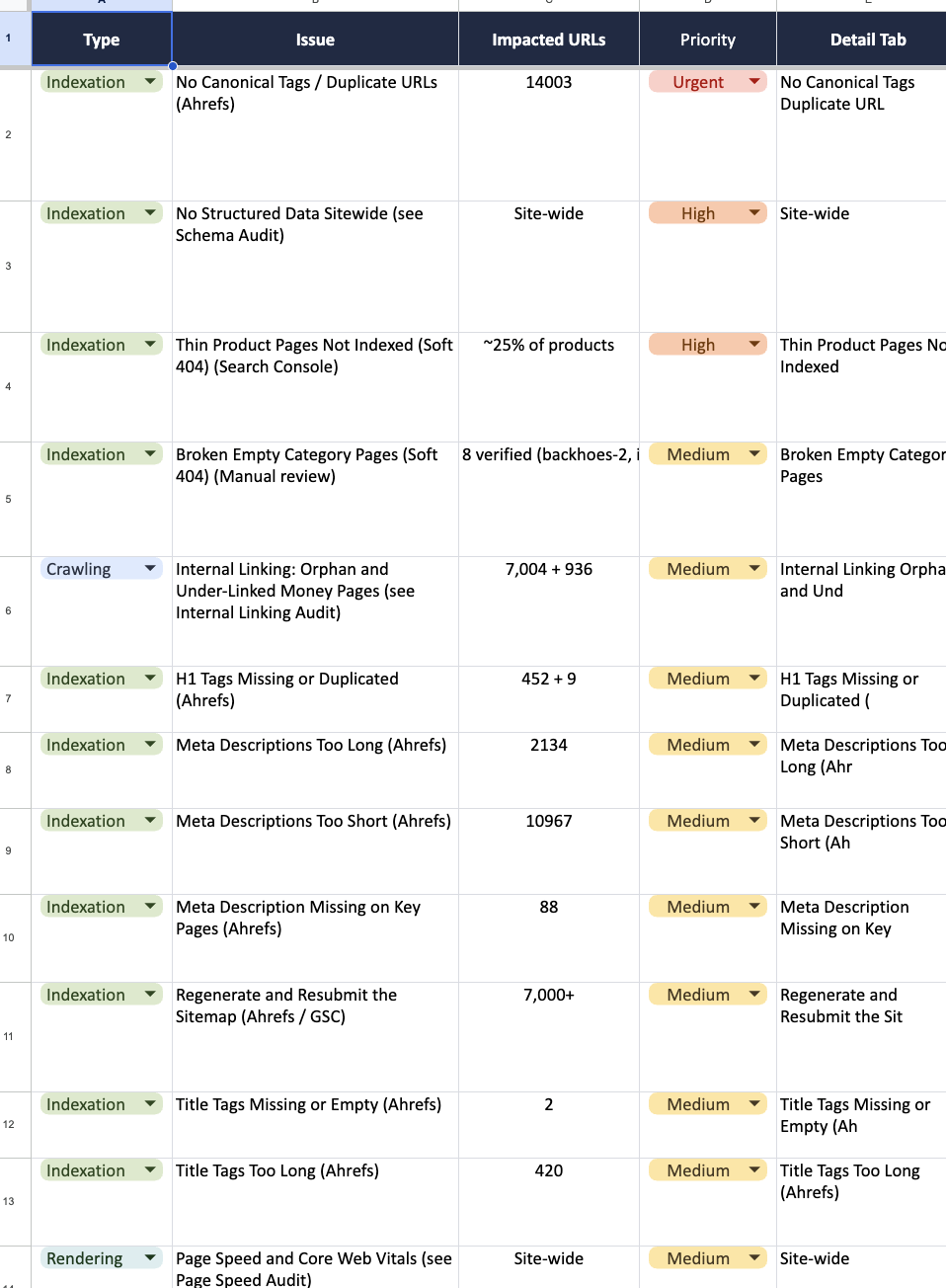
The audit · a slice of the real issue list, prioritised, with impact counts.
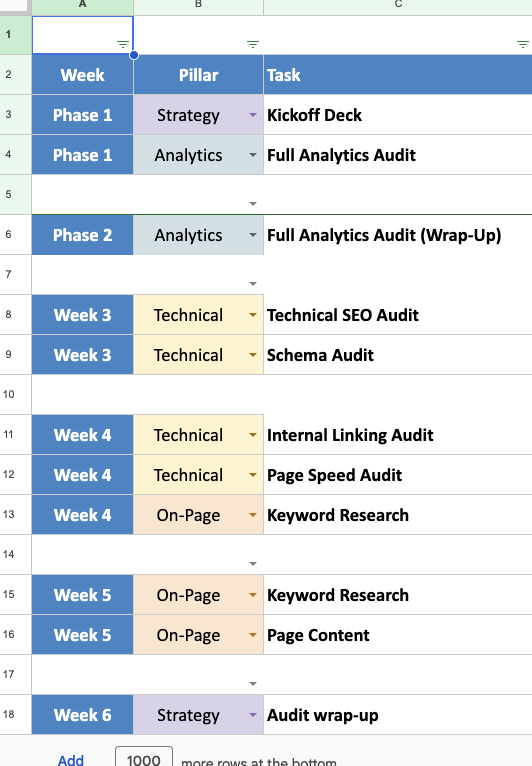
The plan · the phased roadmap we run, from audit to build.
How we run it
Crawl the catalogue, verify every issue live, then canonicalise, redirect or prune dead models.
Product schema on your real spec data, so spec queries and AI answers cite you, not the aggregators.
Non-brand category, product and parts content for buyers who don't know your name yet.
A page per branch with local schema and a clean Google Business Profile.
Specs, comparisons and FAQs for buyers who research for weeks, measured on quality enquiries.
No system access needed. Your team gets the specs, schema and code to ship.
Questions
Most established dealers coast on brand searches, often the large majority of clicks are people already looking for you. The growth is in non-brand, high-intent searches for specific machines, specs and parts, which your category and product pages usually under-serve.
Brand traffic is buyers who already know you. It doesn't win the researcher comparing models across brands. That's where spec pages, product schema and category content bring in new demand.
Because those sites publish structured spec data and yours likely doesn't. Enriched Product schema on your real specs is how you win model-number and spec queries, and how AI engines start citing you.
A dedicated, unique page per branch with local business schema and a clean Google Business Profile strategy, reconciled against your national category demand so branches rank locally without competing with each other.
Usually yes. Discontinued models often sit as thin, unindexed pages, and large catalogues expose duplicate-URL issues. We crawl, verify each issue live, then canonicalise, redirect or prune before touching content.
Yes, on quality enquiries, not raw clicks. We set up conversion tracking on forms, calls and email up front, so the pipeline SEO feeds is visible, not guessed.
No. We run a consulting model. Expertise, specs, drafts and code handed to your team or developer to implement. It suits security-conscious and enterprise clients who can't grant outside access.
We specialise in the SEO of large, catalogue-driven, technical B2B businesses. We bring audit rigour and a proven method to your category, and we're upfront about what we verify versus assume.
A free 30-minute call. We'll show you how much of your traffic is just your own name, and where the new buyers are ending up instead.
Book a call →